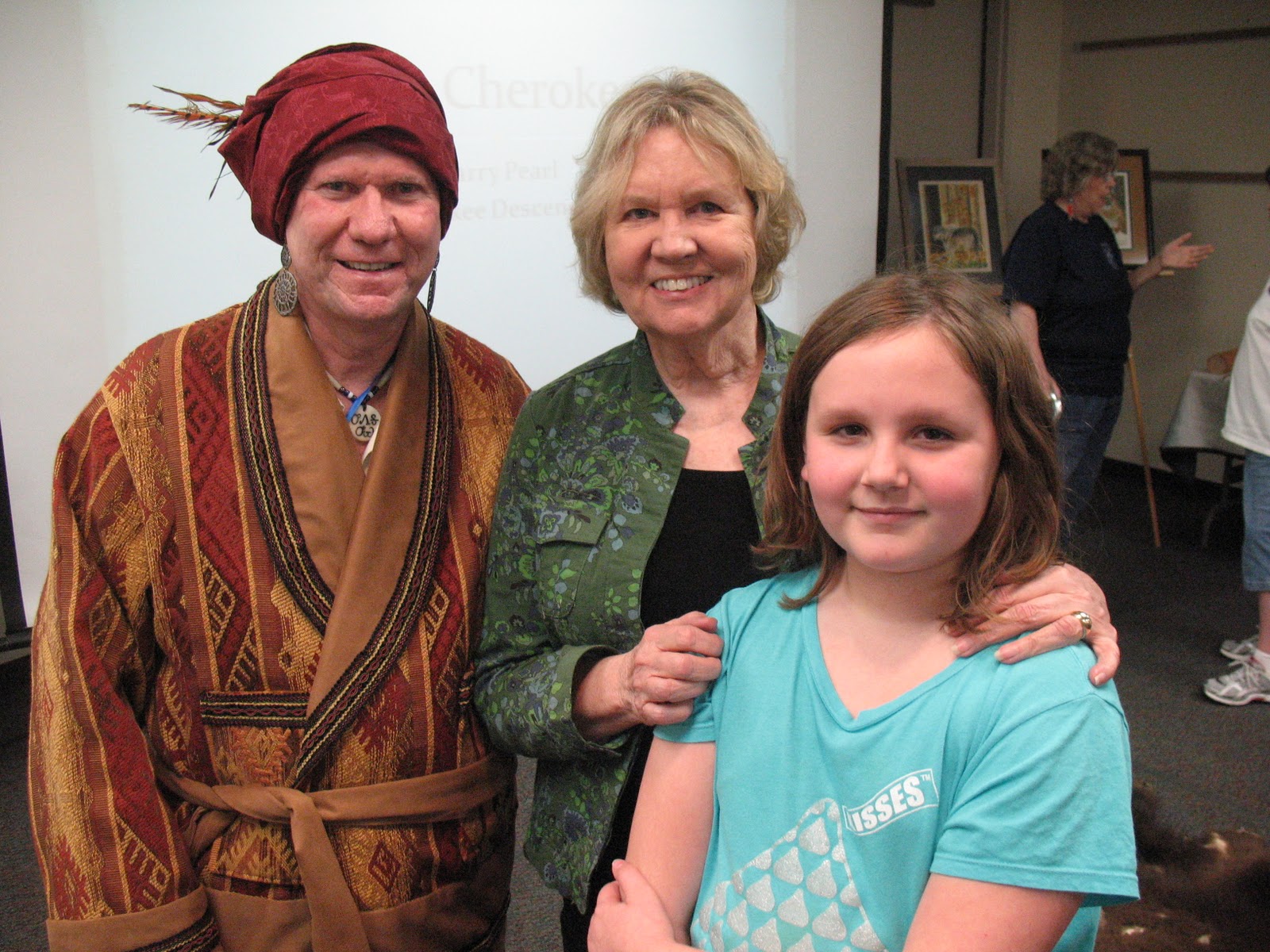
The library had a full house this Wednesday evening for
Larry Pearl’s excellent presentation on the early life of the Cherokee people.
Larry provided fascinating instruction on many of the key events in Cherokee
and Native American history such as the Iroquois Confederacy, Sequoyah and the Cherokee
language, and the Golden Age of the Cherokees, to name just a few. Larry also
demonstrated his knowledge and ability with the Cherokee language. Along with
an excellent PowerPoint presentation, Larry had two tables full of Cherokee
art, instruments, weaponry, and research materials. During and after the Q
& A session, many lively discussions ensued with audience members sharing
stories and memories.
Friday, January 27, 2012
Saturday, January 21, 2012
The Super Hero by Barbara Ann Carle
Barbara Carle is a published essayist and poet and is a featured reader at Friendswood Public Library's Essay Readings on Wednesday, February 29th at 7pm. Also read Carle's The Red Shoes.
I found myself face to face with a
major case of hero worship. How could I
maintain the image Glen had of his brother but talk some sense into him.
The Super Hero
By Barbara Ann
Carle
My oldest son Scott was an
archer. He had a large collection of
bows that he purchased on our trips to the flea market in Canton, Texas. He would often practice in the back yard and
of course, whatever Scott was, his younger brother Glen had to be too. And once Glen decided he wanted to do
something he could be quite persistent. Pretty
soon all we heard was “Can I try? Can I try?” Scott began searching for a bow
that Glen could handle. When he found
the right size; he began teaching Glen and Glen’s best friend Bob archery.
Over the next year both boys got
pretty good. That fall Scott took Glen
to the Renaissance Festival in Magnolia, Texas.
Scott said three men in their twenties were playing the archery game and
they were really bad. They obviously
didn’t know the first thing about archery.
Glen decided he wanted to try.
The three men began to laugh at the little kid trying to shoot an
arrow. With a fair amount of pride,
Scott laughed when he described the scene.
“I stood off to one side. Glen
walked up, put down his money and took the proper position. He pulled back the bow in perfect form and
scored three out of three shots. Those older
guys were stunned.”
One afternoon Scott came to me and
said “Mom I think I have a problem. Glen
and Bob came up to my room today and told me they think it’s time I started
fighting crime. They want me to become a
Super Hero. They want me to buy green
tights and a green shirt and Hgo
out at night with my bow and arrows to catch bad guys. I tried telling them that I couldn’t do that
but they’re convinced I can. I don’t
know what to do.” Scott was eighteen
then and Glen was eight.
Scott and I had a good laugh. The thought of him running around Nassau Bay
in green tights with a bow and a quiver of arrows on his back was just too
funny. “You have to admit, it’s rather
flattering that they’re convinced you can be a crime fighter.” I couldn’t help adding “Come to think of it,
you do look good in green.”
Poor Scott really was between a rock
and a hard place. Glen idolized his big
brother and thought he could do anything.
“I don’t want to hurt their feelings but they just won’t take no for an
answer” Scott said. “Don’t worry, I’ll talk to Glen.”
The next day when Glen came home from
school I sat him down and said “So Scott told me you have a plan. You want him to become a crime fighter.”
The enthusiasm that lit his face
showed me just what I was up against.
“Yeah, he’s a great archer, Mom. He can go out after dark and look for bad
guys.”
“Well, honey you know he can’t go
around arresting people, he’s not a police officer. The police department wouldn’t want him doing
that.”
“There are bad guys out there, right? You’re a police officer Mom and you go after
bad guys all the time.”
“Well yes, but that’s my job and it’s
what I’ve been trained to do. Police
officers don’t want citizens running around trying to catch criminals. That’s what we’re paid to do.”
“So we won’t tell them. You, Bob and I can keep it a secret.”
“But what if Scott gets hurt?”
“He won’t get hurt, he’s too good. You should see him Mom he never misses.”
“I know he’s good but what if the bad
guys have a gun?” I asked.
“Oh he’s really fast Mom. He wouldn’t get hurt. So will you make his outfit Mom? He needs green tights and a green shirt,
maybe a hat too. He could be like the
Green Hornet.”
I was getting nowhere fast. I knew Scott was a good archer but I doubted
he was faster than a speeding bullet.
“You know Scott is really busy, going
to school and working. He has lots of
things he needs to do.”
“That’s why Bob and I will help. Will you make us outfits too, just like Scott’s? And then when Scott’s busy, Bob and I can
take over.”
“I don’t think Bob’s Mom would let
him become a crime fighter” I replied.
“She will if you talk to her, I know you
can convince her.”
I found myself face to face with a
major case of hero worship. How could I
maintain the image Glen had of his brother but talk some sense into him.
“You know Scott starts college in two
months, right?”
“Yeah.”
“And you know college is really hard,
right?” He nodded his eight year old
head. “Well he couldn’t possibly do his
homework, study and work while being a crime fighter, could he? And you know how much he’s looking forward to
going to college. We wouldn’t want him
to fail, would we?”
I could see his blue eyes cloud with
a look of deep disappointment. I got a
dejected “No”.
Shoulders slumped, he turned and
walked away. At the last minute, just
before going through the doorway, he spun around smiling and shouted “That’s
OK, Mom. He can do it on his summer vacation.”
©Copyright – Barbara Ann Carle, 2010
Tuesday, January 17, 2012
Library Lines Redux: Volume 4 Issue 10, 2006
Gangly Noir by Matthew Riley
I first saw her through the window of Webster
Bicycle Shop. She was leaning gracefully, not unlike, yet wholly different from
her inferior replicas. I was 12 and she was a silver and red Rebel BMX racing
bike and she shone like the sun. She was all I longed for during the summer
between seventh and eigth grade. To quench this longing, I took a summer
custodial job at my school in hopes of saving enough money to rescue her from
layaway prison. We rode out together, number 13 displayed proudly on her
handlebar’s number plate. Throughout the remaining summer days, we bonded over
tabletop jumps and high-speed berm collisions. Time and again I lifted her out
of the mud smiling through a grimace. Bruised shins and bent spokes only made
us stronger. And then she went away.
How many minutes I stood staring at the spot in
the garage where she should have been I do not know. Time’s weight crushed me
and I fell without knowing the fall. Days of confused moping ensued and then
finally the righteous anger pointing the way to my resurrection. Four of my
buddies were over later that day and we set up shop at the scene of the crime.
We were the Mystery Gang with five too many Shaggys’, but between us we knew
most every creep hiding behind most every hedge and curtain in the hood. Dog walkers
were no longer walking dogs but answering a few questions about what they might
have seen on the night of the last full moon. Sam covered the 7-11 beat, Mike
down by the creek, Yatu and Torren had the north side and my nose kept
twitching south of the link. For me, this was real. For my buddies, it was just
a fun way to burn the last week of summer.
Just as my time was running out, we had a break. A
friend of a friend knew a guy who had just gotten busted for running a bicycle
chop shop out of his parents’ garage. We were there in minutes and to my luck
the garage doors were open. The first thing I saw was her number 13 partially
visible behind a multitude of bikes and bike parts. As I got a closer look I
could see that her handlebars were on a Mongoose frame. Then I spotted her
forks embarrassingly clutching a yellow Tuff Wheel. Her frame was sporting a
host of Huffy and Redline products. This was a mongrel lot all bent and
betrayed. Unsure of my next move, I bought time by pacing the street in front
of his house. Then I saw him coming out through the kitchen door into the
darkish garage. He was two or three years my senior and thirty or more pound
heavier, but my anger was beginning to grow starting in two small, clinched
fists. Before I knew what I was doing I was standing in front of the open
garage listening with him to the words falling staccato from my mouth, “That’s
my bike. There, and there, and there, and over there.” I could see that he had
been crying and before he could turn his head back around from where I had been
pointing, his tears began to flow again; "Please don’t say anything. I’m
already in huge trouble and I’ll have your bike fixed and back to you by
tomorrow.” I had no reason to forgive him or believe him, but I did and he came
through. Although, she never did feel like she took the berms quite as smooth
or caught the same kind of air as before. As time passed, my interest in BMX
waned and my fret over her lost capabilities diminished to forgetfulness. In my
late teens, I gave her away to someone nearly as enthralled with her as I was
then.
Tuesday, January 10, 2012
4 poems by graphic designer and poet Glynn Monroe Irby
Glynn Monroe Irby lives in Brazoria,
County, Texas. He carries a Bachelor of Arts degree in history from the
University of Texas, Austin, including earlier studies at the University of Houston,
the Brazosport College, and Edinburgh University, Scotland, with subsequent
graduate studies in architecture at the
University of Houston. Irby is the graphic designer and
co-author of the book, 3 Savanna Blue,
the graphic and cover designer of many
other books, and has displayed and marketed photographic and poetic art for homes
and offices. As a writer, Irby has been published in both the Houston
and Austin poetry festival anthologies as well as Sol Magazine, Borderlands
Texas Poetry Review, The Spiky Palm, Galaxy Journal,
Curbside Review, Poetz e-zine (New York), HIP,
and others; Irby has been an invited poet to many
reading venues in Texas, is a member of the Galveston Poets’ Roundtable, the Circle Way Poets, the Poetry
Society of Texas, the Gulf Coast Poets, and was selected in
2006 as one of the “Bards of the Bayou.” For many years, Irby has been a
manager, buyer, and professional interior planner in his family-run furniture
and design business.
Look for Glynn Irby to be a reader at the FPL Poetry Series reading on Wednesday, July 18th at 7pm. The Friendswood Public Library carries 3 Savanna Blue. Ask for assistance at the reference desk.
Tall Grasses
Can
you hear that sound
of
tall grasses in the wind,
that
sound of decades-hay
before
the final shocks are made?
Listen
to the whirling overhead
of
golden crowns in the sky,
the
sound of grain heads
yielding
their seeds into the frantic air.
Listen
to the sound of shadowy things
harbored
inside the bramble,
and
that bursting sound of cracking
through
unyielded early stems.
Listen
to the raging of change
through
my soul,
the
sound of breaking cane
and
the shattering of my secret places
as
you clearly pierce the last
of
my perimeter reeds
onto
the outer boundaries
of
my dispersing reservoirs.
Glynn Monroe Irby
White and Grey Dominiques
— from my father’s farm stories
When
night comes, some chickens
go
to the woodhouse, others fly
to
branches of the apple tree.
Now
and then after midnight,
the
sly weasel with razor teeth,
quiet
on the balls of his feet,
sneaks
up along the creek,
slips
under the hawthorn hedge,
and
climbs the bountiful chicken tree,
takes
his pick among resting hens.
Each
morning when leaves
are
wet with dew and I start
my
long walk to the schoolroom,
I
watch for blood feathers
in
the clover bed.
Glynn Monroe Irby
Sailing Together
Steering
our chalk-white catamaran
toward
rising constellations,
we
slip through the scattered sea
beneath
a patterned sky,
leaving
the sun in our wake.
Sailing
in line with moon-tides,
cross-grain
to ghostly grey passages
of
young pelagic jaegers, we attend
to
combinations of changing
currents
and wind direction.
We
listen for the cry of laughing gulls
or
the whisper of a shore break
as
we delight in the exuberance
of
blood pressing through our veins,
engage
in an echo of emotion,
experience
the chorus of heaven,
and
the thundering voice of God
in
the sudden electric storm-rage
before
morning.
Glynn Monroe
Irby
Knowing the Tides
She
advances straight
into
my channel access,
then
recedes through
the
swelling sluice
toward
the open sea
once
again.
Still
in the morning
her
fresh water-beads
collect
on the dew-lips
of
my over-edging grasses
before
slipping back
into
the stream.
She’ll
then ascend
into
the anvil clouds
to
flash violently back
into
the dark waters
of
the open ocean
once
again.
Glynn Monroe
Irby
More poems by Glynn Monroe Irby:
Wednesday, January 4, 2012
Cherokee History, Culture and Language at Friendswood Public Library
Larry Pearl, a resident of League City, was born in Oklahoma and is a descendant
of the Cherokee people. He will be giving a presentation that will cover many
aspects of early Cherokee life. He will share his knowledge about this important
part of our American history and demonstrate how European and Cherokee cultures
were influenced and developed over centuries of contact. This will be a fun and
entertaining evening for all.
Wednesday, January 25th at 7pm in the Friendswood Public Library Activity Room.
Thursday, December 15, 2011
3 poems by author, artist, and poet Dodie Meeks
Dodie Messer Meeks has poetry in a couple of hundred journals and literary magazines and several anthologies. The Arts Alliance Center of Clear Lake published an illustrated collection of her work, entitled, “When I Got Dressed Again.” She is currently illustrating a children’s book of poetry for the publishers of The Lyric, which she describes as “the only poetry publisher older than I am, which is pretty amazing.”
MARY, MARY
Outside the window of my room
Big creamy plates of bloom
Keep spilling charcoal seeds.
The bees are slurping out there, dazed,
In two hundred proof magnolia
couched in leathery leaves.
All up and down the block
The neighbors’ lawns
Are clipped formica neat
But my garden
That they can hardly stand
Is all elbows and knees.
Salvia slavering down the walk
Ivy shinnying up the stalks
Of three kinds of anemone
Rioting as anemone can
Each stem erupting into ten.
That hospital gift gardenia
We gave a decent burial
Is pop-corned over with bloom
Enough for a funeral or two
Crowding a candelabra of lilies
Budded so aching tight
It hurts to look.
Those roses that you sent
Claw through whatever this is,
With veins of tattered blue
On international orange.
And I know I never put in
This goofy garlic patch.
That sad, young, wandering priest
We let sleep on our sofa for a spell
Was a fussy eater. These might be
From the kernels he threw out.
It’s taking on the mint.
Well. You know mint.
Smells like a candy cane
Has the soul of a virus.
They said to contain it
But don’t tell me
What to do with my darn mint.
So here’s a carpet of that.
Too thick to get a grip on
But for a leaf or two, for tea.
And here come some caladium
Unfurling burgundy veined with green.
The brass section. Aren’t they
Supposed to come back small?
Where you are, in London,
Crocuses peek through snow.
In Holland the tulips are marching along
Row on proper row.
Like ads for laundry soap.
But they have that purple scent.
It’s illegal to let poppies grow
In Greece. But they do, anyway,
Their hairy stems
Claw up through rock
Gasping for a breath of mist.
Boy. It’s moist here all the time.
I can stand in the middle of my house
And feel my garden buzz and seethe
Like mother, yanking on a sequined blouse
To wear to church. Saying whee.
Whoop de doo, Jim. Whoop de doo.
It’s just the gypsy in me.
Dodie Meeks
ATAVISM
We are grown unaccustomed now to trees.
They lean above and breathe a trailing mist
that slides in on all sides. They sway and list.
We urban dwellers stand and stare at these
as the Apaches did. They neared this mound
and signaled for silence. Quivering, intent
the shadowy riders listened, quickly bent,
slid down, and made their way around.
They saw the shape embedded in this stone.
We are grown unaccustomed now to these
contrivances of seed, these symmetries
of bark and darkened overlapping cone.
Was it some sudden silence shimmering
in rotted leaf and spears of splintered light
flickered the green gold sun as cold as night?
Or some large eye, half-open, glimmering?
Dodie Meeks
Advice for the Bride
Dear little ladies with dear little voices
Have ended upended on ant teeming slopes
Or, after a tiff, have been dropped from a cliff,
Or dangled forlornly on slow-turning ropes.
Girls who must have the last word every argument
Have eaten their words in a dank dungeon keep
Or languished in stocks or been fed glowing rocks
Or watched cablevision and given up sleep.
Ladies with tongues far less acid than mine is
Gurgled on guillotines, writhed on the rack.
All that I have to fear—tell me I’m lucky, dear—
Is the dank certainty. He won’t be back.
All my proud sisterhood, swearing you will be good,
Wishing indeed you could be still as stone.
Raise your arm. Make a fist. Swear to remember this:
Grammatical errors are best left alone.
All my proud sisterhood, knowing too well you should
Be ever so careful to leave it unsaid.
No matter what you hear always remember, dear,
Never correct a man’s grammar in bed.
Dodie Meeks
Other poems and illus. by Dodie Meeks:
Wednesday, December 7, 2011
4 poems by teacher, poet, and naturalist Richard Peake
| Richard Peake in an African village in Sierra Leone on a birding safari. |
Richard Peake has been a featured poet at Friendswood Public Library poetry readings and we look forward to having him back in early 2013.
Electric Wings for Ars Poetica
Like arctic terns in flight
from pole to pole
or swallows speeding to new nests
or metallic birds
that outpace the speed of sound
words grow wings
to fly around the world
as we let our thoughts migrate.
For sad or happy thoughts
there is no transport like a poem
to speed emotions forth.
Across barriers of land or sea,
a poet’s words
can bring us serious things
or just a clever jest
to lift the poet’s wit with wings.
With the speed of wireless phones
or the internet
words fly faster than terns or swallows
or sound-barrier-breaking planes
So let my poem
ascend on electric wings
to speed my praise
of a time to honor poetry.
published in The Book of the Year 2010
My Cousins’ Fledermaus
Their ID erred dismally.
I’m sure they didn’t know tequila can’t exist
without bats flying like night moths
to pollinate agave plants. And being only five
I was just as ignorant of the good bats do.
My aunt and cousins, confused by the German,
treated the poor flying creature
as if it were a mouse they dreaded
and might have stood on chairs to avoid
unaware that bats gobble night-flying insects,
not Mississippi women afraid of mice.
For them the flying mammal wandering in that night
brought dangers from a dark, bloody world
to tangle in their flowing locks
and suck their luscious virginal blood.
My cousins wielded weapons against this flying fury
whose fangs appeared ten inches long
to them, though to the young boy
hiding under a convenient table
the bat seemed fangless, distraught, befuddled
by the lights and by the brooms
belaboring it in awkward pursuit of its frantic flight—
a beast thought at the very least to carry rabies
from the haunts of vampires.
Screams and commands and deadly swipes
filled the room with eager mayhem
as bloodlust born of fear prevailed.
The flying mouse could not escape into the night.
Amazon warriors soon displayed to me its limp,
lifeless body—exulting in their victory
over the dark forces of the summer night.
published in Raven Images, Nov., 2010
I Favor Three-toed Sloths
for Theodore Roethke
Volcano watching, ungainly two-toed sloth
fell out of a scenic too-slender tree,
broke limbs, narrowly missing me—
clambered, slipperied back up with baleful wroth.
Clumsy two-toed, too-inquisitive sloths—
less careful how they climb and doze
than clever species with three toes—
should try pledging visitors troth.
Canny three-toed sloths know slow
moving. You might deem them smug
as they give branches a hug,
ex-as-per-at-ing-ly slow they move from high to low.
You jump and yell and try to wake them
but deep in sleep slowly they go
swaying in the breeze by their three toes
unheedful of your stratagems—
they blink—you know they know they know.
published in Asinine Poetry, Feb., 2010
No Meals, No Songs
Unnatural landscapes breed no song,
provide little food for nestlings.
Like blue gum forests in strange lands
yards of aliens yield no songsters.
Insects loiter in native plants
not aliens they cannot digest.
Where no caterpillars devour
live trees and bushes, no birds sing.
Exotic herbs planted for show
live free of bug bites and cocoons,
free of warblers and tanagers
who find no insects to digest.
published in Nature Croons, Apr., 2011
More poems by Richard Peake:
Subscribe to:
Posts (Atom)