Tuesday, March 6, 2012

Celebrate National Poetry Month with Host John Milkereit and Net Poets Society

                                                                        John Milkereit began writing poetry after taking a seminar on the poetry of Billy Collins in 2005 at his local church. His poems have appeared in Harbinger Asylum, Swirl, Poetry Revolt, the Texas Poetry Calendar and has been a juried poet at the Houston Poetry Fest the last three years. He also recorded several of his poems at Taping for the Blind. Pudding House Press published his chapbooks in 2010, and Paying Admissions was a Finalist-of Note in their 2009 chapbook competition. During the day, he is a rotating equipment specialist at a Houston engineering firm.

Come hear host John Milkereit, with poets Erica Lehrer, John E. Rice, Mona Follis, Dede Fox, and Adamarie Fuller at the Friendswood Public Library on Wednesday, April 4 at 7pm.


 Geisha
  
These nicknamed men,
                                   they aren’t looking for porcelain around Japan.
They aren’t looking for antique bronzes: just one-night jack stands.

They aren’t thinking about their seed on a kimono, or these broken
bits of concrete from the bombed factories.  Their Gucci boots
occupy the front door sleeker than my dogs.

But I was later proved wrong: Blue Bear outbid
the others for my danna.
                                   Cher doux ours bleu—
the truffle that preserved my sunflower oil.  He kept me from eating
charcoaled squid in graveled dirt.  He had tufts of hair
higher than the cliffs at Normandy beach.  He whisked me to his cave—
a farmhouse south of Provence.  We saw movies, Judy Garland,
and I swear he growled at the wicked witch and those flying monkeys.
Who would have thought a geisha could survive in France?
I wore black scarves around the village and caught fish
from the river and carried them to market in town.

Time for me is a jigsaw puzzle, now, years later, pieces scattered
upside down in an unlucky frame, the misfortune of Blue Bear’s
cancerous death is a crooked edge and now this moment,
       this dance back to Kyoto
is a piece of movement that doesn’t fit.
                                                          I’m addicted,
old Japan, to your spiderworts, your pickled sour plums,
                               your eyebrows of cooled paulownia twig,
               your drink of sake fantasy. 
I will nurture my little cub—mon petit ourson bleu—
in your land held by silver thread
                interwoven in a brocade of folded
                     rusts and golds.   

--- John Milkereit


Folk Song                                                                                              
The first note is almost struck.
A string could be picked at any moment.
You aren’t hungry yet.
Think of a guest entering the shadows
in the front room of your house.
This is the minute before midnight
when she turns seventeen.
The dynamite is fused in the coal mine.
The dragon is still asleep in the cave.
The lead singer introduces the piece
with words that tell us about the rise.
We could even have an Oh, yeah. Oh, yeah.
This is the inkling a war veteran
has to hammer a ring for his wife.
This is the train conductor saying All Aboard!
This is the prelude to your first kiss with her,
your first night with someone else. 
This is the section where the tracks turn green,
where lawn chairs outstretch,
when the lawyers draft your will.

The next part is the layer beneath the upper crust.
The coffee is stirred, the yokes burst on a plate.
Here the singer detours into a Paul Simon riff
or tells us how George Harrison autographed his guitar.
You begin to love a waitress with amnesia.
Photographs develop of you littering in the city dump.
Chris McCandless leaves for the wild.
This is the car driving towards the tornado.
This is the verse that puffs fire or explodes
and suddenly goes quiet.
The developers have re-named the place
after what they’ve torn apart.
The bridge spans thin air, but the oxygen bottles
are 3000 feet below.
This is sitting in the street for justice.
You’ve entered the witness-protection program in Anchorage.
So much of this song is quicksand, so much confusion—
snow in Austin, the break of a string, an appendix swells,
your friend does crack from a Coke can, the first gardenia
blooms, you leave Savannah on Christmas Day—

This is the last trimester.
The Jayco rental is almost over.
The pony is too small to ride.
This is the time to harvest corn,
dry ears in the bin.
The singer belts higher than what she sang before,
she goes down an octave or two, pleads the audience to sing.
Soap bubbles blow from the side stage.
Black sheep flock the front yard
careful not to nibble at the bodies of background vocalists.
Here is the last bit of change for the New Jersey Turnpike,
and your house echoes with haunting laughter.
The final strumming is the grave sounds we imagined.
This is what Arlo Guthrie lived for,
what rhythm we should feel like in the floorboards
before our heads are cut off.
This is the bell chime that begins a funeral
under the blood of stage lights.
This is a raccoon leaving a hollowed tree
outside a blanket of stars,
and above, or maybe inside the ribcages,
we hear the chords of each other’s angels.


---John Milkereit


Saturday, March 3, 2012

Meet illustrator and poet Duckie and the Grackle

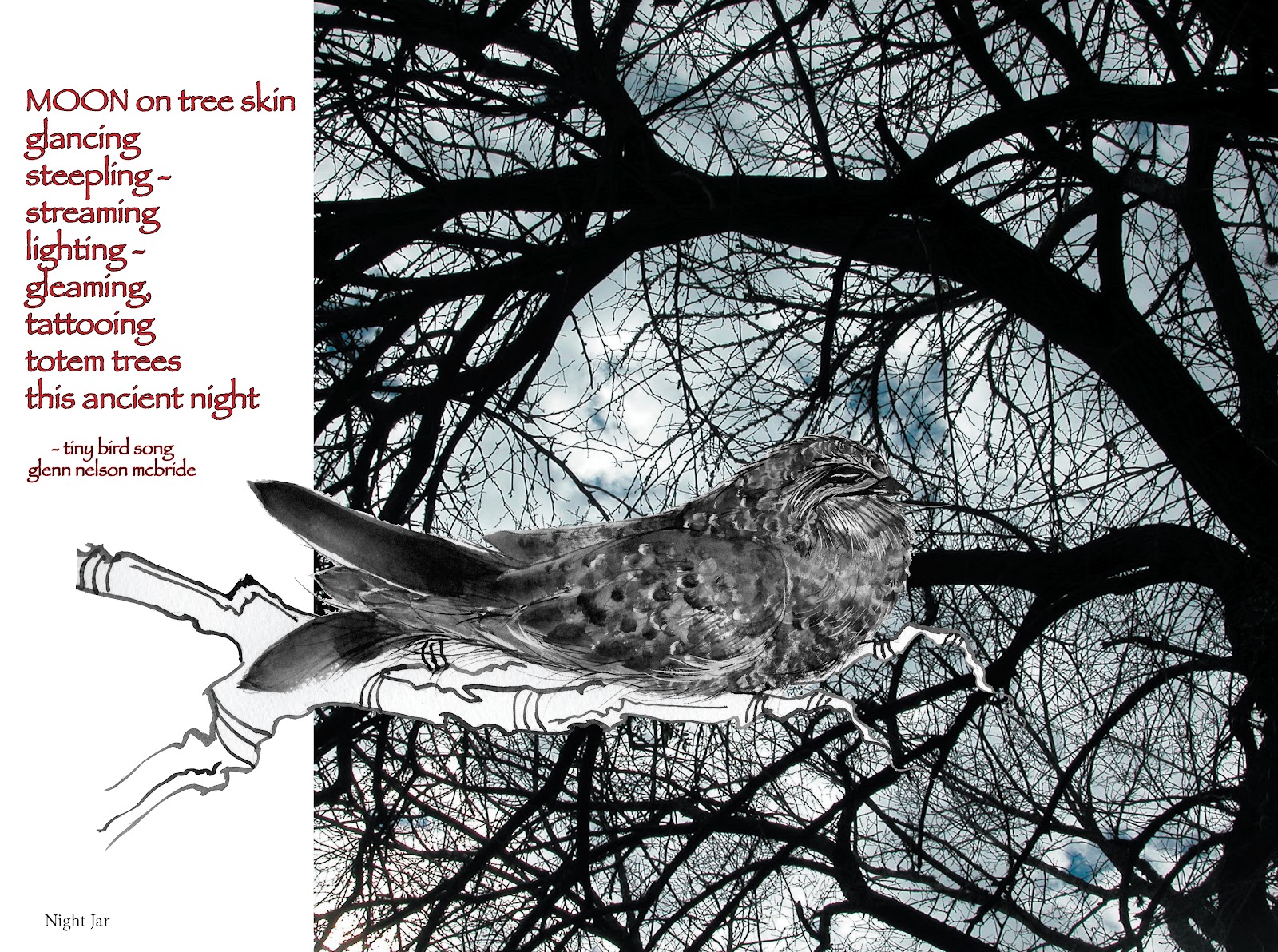
The TINY BIRD SONG Illustrator - 
CHERIE NOWLIN MCBRIDE (AKA Duckie) grew up in a small town on the industrial Texas Gulf Coast. Her mother would have preferred that she become a teacher, but she managed to "get away to art school." 
Art school paid off and soon! She went on to help produce the original Houston Astrodome scoreboard animations and then became a filmmaker in Alaska. Later, she returned to her hometown to join the family business. 
Life refocused to intensive art when Cherie and Glenn McBride married in 1985. Both feeling cloistered with business careers, they plunged into night school pottery classes. The open-ended creative feeling of molding fresh clay and firing pots changed their lives forever.  
In 2000, Cherie began painting and showing nature art at festivals. By 2004, the "creative couple" had decided to develop a series of "tiny bird songs" - illustrated nature poetry for posters, calendars, books and planners. The purpose would be to heighten awareness and feelings for art, wild birds and nature around the globe. 

The TINY BIRD SONG Poet - 
GLENN NELSON MCBRIDE (AKA the GRACKLE) grew up as the only son of a blacksmith in the small town of Bluegrove, Texas. Not caring for "basketball high school," he joined the USMC at age 17. While overseas, he became intrigued by stories about the determination and success of Pablo Picasso and vowed to enter college one day to learn more of art and literature. Then after 4 years service, this U.S. Marine (still in the reserves) found himself sitting in class at Midwestern University and suffering serious nosebleeds while listening to the overwhelming lines of Keats, Shelly, Dickinson and other great poets.  
At age 39, Glenn finally received a degree at the University of Houston/ CLC, continuing on to complete graduate studies in behavioral sciences. In his fifties, he became a founding member of the Brazosport, Texas Poets Society. Now in his sixties and realizing the mindless destruction of our natural environment, "the Grackle," along with his wife "Duckie," has focused on "awesome nature" and the outdoors - through their Tiny Bird Songs.


Friday, February 24, 2012

Breaking Cornbread by Nanci Engle


Nanci Engle is from West Virginia and remains a mountain girl at heart. 


She is a visual artist, as well as a poet and essay writer.  She started writing four years ago at a point in her life when she felt she had nothing to say and that no one would listen and quickly became known as the member of the writing class who would literally be writing in the car on the way to class and in the hallway before the teacher closed the door to the classroom.  When it came time for her to read, the instructor would always ask, "Are you going to make us laugh today, or are you going to make us cry?" 

Nanci is currently a member of The Easy Writers.

Hear Nanci read her work on Wednesday, February 29 at 7pm at Friendswood Public Library.


Breaking Cornbread


Today I stood on my tip-toes
and used both hands
to take the heavy iron skillet down from the shelf,
then slid it into the oven for warming.

Today I solemnly, almost reverently,
 measured and mixed cornmeal, flour,
 salt, baking powder, shortening,
 milk, and eggs.

Today I poured that golden batter
into the piping hot skillet
and placed it in the oven to rise,
bake, and transform its simple self.

Today I laid an altar on a placemat
with a single plate, a knife, a soft cloth napkin,
and a nob of softened sweet cream butter.

Today I carefully pulled that hot skillet from the oven
taking a long moment to savor the aroma
and to admire the crispy brown edges.

Today I sat with my hands folded in my lap
and my heart full of thanksgiving.

Today I broke that bread and I cried.

I cried because each year on May 27th,
my Momma’s birthday,
my friend Elizabeth would share a bowl of strawberry ice cream
with me because it had been her favorite.

I cried because each year on June 22nd,
my Daddy’s birthday,
my friend Elizabeth would share a slice of pecan pie
with me because it had been his favorite.

I cried because it is February 19th,
and it is a new year,
and I am breaking cornbread
for Elizabeth.


In memory of Gladys Elizabeth Kalil
1919-2010

Nanci Engle
Copyright©2011
 

Thursday, February 16, 2012

Full house for Crawford presentation!

The Friendswood Public Library had a great turn-out and a wonderful reception for Mark Crawford's presentation on The Book that Changed the World. A chronilogical history of the making of the King James Bible was presented in fascinating fashion. Mark also provided insight into the impact the KJV has had on the world of literature and the English language in general. The evening ended with several great questions from the audience. We hope to have Rev. Mark T. Crawford back again for another excellent program.


Presentor Mark Crawford (left) with linguist, professor and columnist Harold Raley


Monday, February 13, 2012

Iron Horse Blues 1932 by Diana Dettling Buckley


Iron Horse Blues 1932


Rail yards, mostly empty

cluster of thugs by the barbed wire fence

trouble in the cards, jokerʼs gone wild


Whistles shriek, bells clang

smoke stacks belch

tireless wheels march

closer to the glinting moon


Inside a boxcar, hobos huddle

hum soulfully, strum an old banjo

ride free to their strange destiny


Restless thieves hop the train

angry curses meet flying fists

someone shouts knife!


Morning papers scream

Murder on the Galveston Express


by Diana Dettling Buckley


Diana Dettling Buckley will be a featured reader at the Friendswood Public Library on Wednesday, February 29th at 7pm. Other essayists will include Barbara Carle, Kay Cox, and Nanci Engle. Read Diana's essay Summer Holidays.


Tuesday, February 7, 2012

Clyde and Chester, The Investigators by Chester P. Karrick, Jr.

The following investigative report, Over the Fence They Will Go, is taken from the Chester P. Karrick, Jr. book entitled Clyde and Chester, The Investigators: Fraud, Embezzlement, Theft.  More reports are to follow.
On Monday, April 9th at 7pm, Author Chester P. Karrick, Jr. will be at Friendswood Public Library to discuss some of the investigative cases conducted by himself and legendary Houston private eye, Clyde A. Wilson.
From the Introduction---Chester met Clyde Wilson when Clyde was hired as a full time Security Consultant for the company that employed Chester.  Chester was an assistant director of internal audit when requested to assist the security consultant on a fraud matter that started a working relationship that lasted for many years.
During their work together, Clyde and Chester conducted over 300 investigative and security review cases that resulted in the conviction and termination of many employees.  Fraud of many millions of dollars was uncovered with millions being recovered from employees, third parties, and fidelity bond insurance claims.
The author selected fifty-nine of the most representative investigative cases covering many different areas and types of business…
Readers of a prior self-publication of this book who personally knew Clyde and Chester have suggested that some of the cases included herein might make an interesting TV series.  Tom Selleck was suggested to play Clyde and Danny DeVito to play Chester as the physical resemblances are amazing. Unfortunately, since the first publication of this book Clyde has passed away.  This is the first book the author has written and is now living in Friendswood, Texas with his wife. They have one daughter. Chester is now serving as a business consultant.


Over the Fence They Will Go By Chester P. Karrick, Jr.

While at the same location as the “Paint and Lead Caper” fraud covered in the prior chapter, Clyde and Chester were sitting in their rental car at 7:00 am one morning watching 30,000 employees file through the entrance gate to clock in for work.
A few minutes after seven they noted that several employees were jumping over the fence at the north side of the plant premises.  They counted about 80 employees jumping the fence. Clyde and Chester could only conclude that the employees had entered the plant, clocked in, and were heading up the street to who knows where.  Leaving the car they followed the employees for about six blocks. The employees entered a beat-up-looking building that was owned by a competitor of the client.
Previously at the plant, Clyde and Chester had learned that their client had lost several major repair jobs to the competitor.  The client could not understand how he was being under-bid on the jobs or how the competitor had enough skilled employees to perform an acceptable job.
Clyde and Chester took turns during the day observing the competitors operation.  About 10 minutes before 4:00 pm, they noted the client’s employees were leaving the competitors plant. They headed down the street to their permanent place of employment.  The employees jumped back over the fence into the plant, presumably clocked out, and left the plant.  Thus it appeared that the employees were paid a day’s work by the client and then went down the street to the competitor’s plant, worked all day, and earned an additional day’s pay.
From an unnamed source, Clyde and Chester were able to obtain a copy of the competitor’s employee payroll list. The names on the list were compared to the client’s employee payroll list.  Sure enough, about 95 names were found on the lists.  However, the competitor was paying only about 70% of the hourly rate paid by the client.
The next day Clyde began interviewing the 95 identified employees and after taking signed statements covering their improper activities, the employees were terminated.  While Clyde was finishing with the “fence jumpers’’, Chester began reviewing surplus material and scrap material sales.  
Chester selected one major job he had heard was finished the year before which reportedly had about $10,000,000 of new, unused, surplus steel products left over from that project.  Checks of inventory files and records together with interviews of several appropriate personnel failed to disclose any information relative to the surplus parts.  No one seemed to know, or would admit, knowing anything about the surplus.  No sale of these parts could be found.
As the type of materials left over on that job appeared to be the same type that could be used by the client’s local plant competitor, Chester felt there was a possibility that the competitor was somehow getting the client’s new surplus materials at bargain prices.  If the competitor was getting labor at 70% of the client’s cost and materials at a bargain price, this would explain why the client had lost bids on several major repair jobs.
Since the plant operation generated a lot of scrap material as well as surplus parts, the whole scrap and salvage operation became suspect.  Chester reviewed the available records to determine which companies were the major buyers of surplus and salvage.  It was not until later they learned that most of the scrap yards on the East Coast were reportedly controlled by the mob.
Chester and Clyde starting interviewing scrap dealers in the area to find out how they obtained their client’s business.  In their first visit to a local small scrap operation owned by a man who was reportedly honest, Clyde and Chester introduced themselves and stated their business.  The owner, who was about seventy years old, started bragging about how young he felt.  He said he could kick out the light bulb hanging high over his head. To demonstrate, he stepped back and proceeded to kick the light bulb.  Clyde exclaimed, “Wow, you sure are agile.” The owner grabbed Clyde by the throat and said, “Don’t you cuss me man.” Chester had to pull him off shouting, “No! No! He’s not cursing you, agile means you are quick, nimble and active.” The owner grumbled, “Well, OK then.” Clyde was able to cultivate his trust and received much helpful background information on many scrap dealers in the area.
About 9:00 pm the next night, Clyde and Chester were driving around the area surveying various scrap dealer operations when they noticed a light on in a scrap dealer’s office.  They decided to go in and talk with whoever was inside.  Upon entering the office, a man looked up from his desk and said, “Well, Clyde and Chester. I wondered when you would stop by.” Clyde and Chester looked at each other in amazement, as they had no idea that anyone there would know their names.  The man reached into a desk drawer and tossed a big brown envelope onto the desk.  He paused about a minute, and then reached into another desk drawer and pulled out a 45-caliber pistol, pointing it at them.  He said, “There is $50,000 in the envelope. Then shaking the pistol at them, he said, “Take your pick, which one do you want?” Clyde and Chester looked at each other, then turned and walked toward the door, stating, “If you shoot us, you’ll have to shoot us in the back.” Driving off in their rental car, they knew they were getting close to a big-time scrap fraud as somebody was beginning to feel the heat.
Clyde and Chester then decided it was time to investigate the entire surplus and salvage operation.  Most of the client’s plant scrap was being shipped out by rail car.  The rail cars were pulled onto the client’s weight scale, weighed, and moved out of the plant.  Clyde and Chester reviewed the weight scale procedures.  They noted that inside the scale room, weight tickets were stacked to the ceiling all around the room. They were told that copies of the tickets were kept for years and years in case any question came up about the weight of any rail car.  This seemed ridiculous. Clyde examined the scales and noticed that by moving the scale apparatus with his finger he could print out any weight from zero to 200,000 pounds.  Suspecting that the weight man had some kind of deal going, Clyde took him aside and began interrogating him.  In a little while, the employee admitted that for over twenty-three years he had been shorting the weight on every rail car by several thousand pounds.  For his endeavors, a local scrap dealer left a fifth of whiskey by the employee’s car every Friday afternoon.  The man’s fraud had cost the client thousands and thousands of dollars over the years.
Since the local scrap dealers were taking advantage of the client’s scrap and salvage sales, Clyde and Chester then concluded that the scrap dealers were also fraudulently obtaining surplus materials and parts from the client.  As the client’s local plant competitor was using the client’s labor, Clyde and Chester then surmised that the competitor was also receiving materials and parts from the client.  Chester thought it probable that the local competitor company had inside information on the client’s surplus material availability.  The competitor might be ordering needed parts for repair jobs obtained by submitting lower bids than the client.  Conducting a review of property records at the courthouse, Chester learned the competitor company owned an old building at the edge of town.
Driving by the location at night, they noted bars on all the windows.  The building appeared to be well secured although there were no guards in the area.  Looking through the windows, they observed that the building appeared to be used to store materials and parts.  Clyde and Chester speculated that some of the client’s surplus materials might be inside.  With the assistance from a local investigator, they were able to enter the building.  They found that the building was substantially full of surplus materials and parts obviously obtained from the client.  Chester also found the inventory records covering the $10,000,000 in surplus parts he had previously been looking for at the client’s plant.  The client’s name was still on each inventory card.  It appeared that the competitor had obtained all the parts together with the applicable inventory records.
Suspecting that the client’s scrap and salvage manager had a hand in this matter, they returned to the client’s office where Clyde began interrogating him concerning their suspicions.  After an hour or so of denials, the manager finally admitted to having sold $10,000,000 in new, unused, surplus parts to a local scrap dealer for $70,000.  He knew that the parts were destined for the client’s competitor.  The manager admitted to receiving a used Pontiac worth about $3,000 for making the deal.
As the whole purchasing, scrap and salvage operation was so rotten and mired in fraud; Clyde and Chester were able to obtain a Grand Jury investigation into all related matters at the client’s plant. The yearlong Grand Jury review resulted in numerous indictments and convictions of client employees and local persons involved.  Insurance bond claims were filed to recover the client’s losses.


Wednesday, February 1, 2012

The Book that Changed the World with Mark T. Crawford

Wednesday, February 15th at 7pm at Friendswood Public Library

Mark T. Crawford will speak about the historical and political setting of 17th century England as it pertains to the King James translation of the Bible. The King James Version, known to the world as the KJV, has been a best-seller since its publication in 1611. Mark will also speak about the KJV's lasting impact on the world of literature.
Rev. Mark Crawford was educated at SMU, Dallas and Oxford University before completing his Doctor of Ministry Degree at Austin Presbyterian Theological Seminary. Mark serves on the Diocesan Commission on Ministry, the General Board of Examining Chaplains and is a member of the faculty in the IONA School for Continuing Education. He now serves as Staff Chaplain at St. Luke's Episcopal Hospital in the Texas Medical Center.
Rev. Mark Crawford's reading list:

"The Book of Books" by Melvin Bragg. Berkeley:  Counterpoint, 2011.

"In the Beginning" by Alister McGrath. New York:  Random House, 2001.

"Manifold Greatness, ed. Helen Moore and Julian Reed. Oxford: Bodleian, 2011.

"The King James Bible - Making a Masterpiece" by Adam Nicolson. National Geographic, December 2011.

"KJV at 400" by Jon Sweeney. Christian Century, July 12, 2011.


The Friendswood Public Library carries The Book of Books by Melvin Bragg. Both journal articles can be found in print or electronic versions through the Friendswood Public Library's Ebsco Journal Databases. See the reference desk for assistance.

Friday, January 27, 2012

Cherokee Presentation at FPL

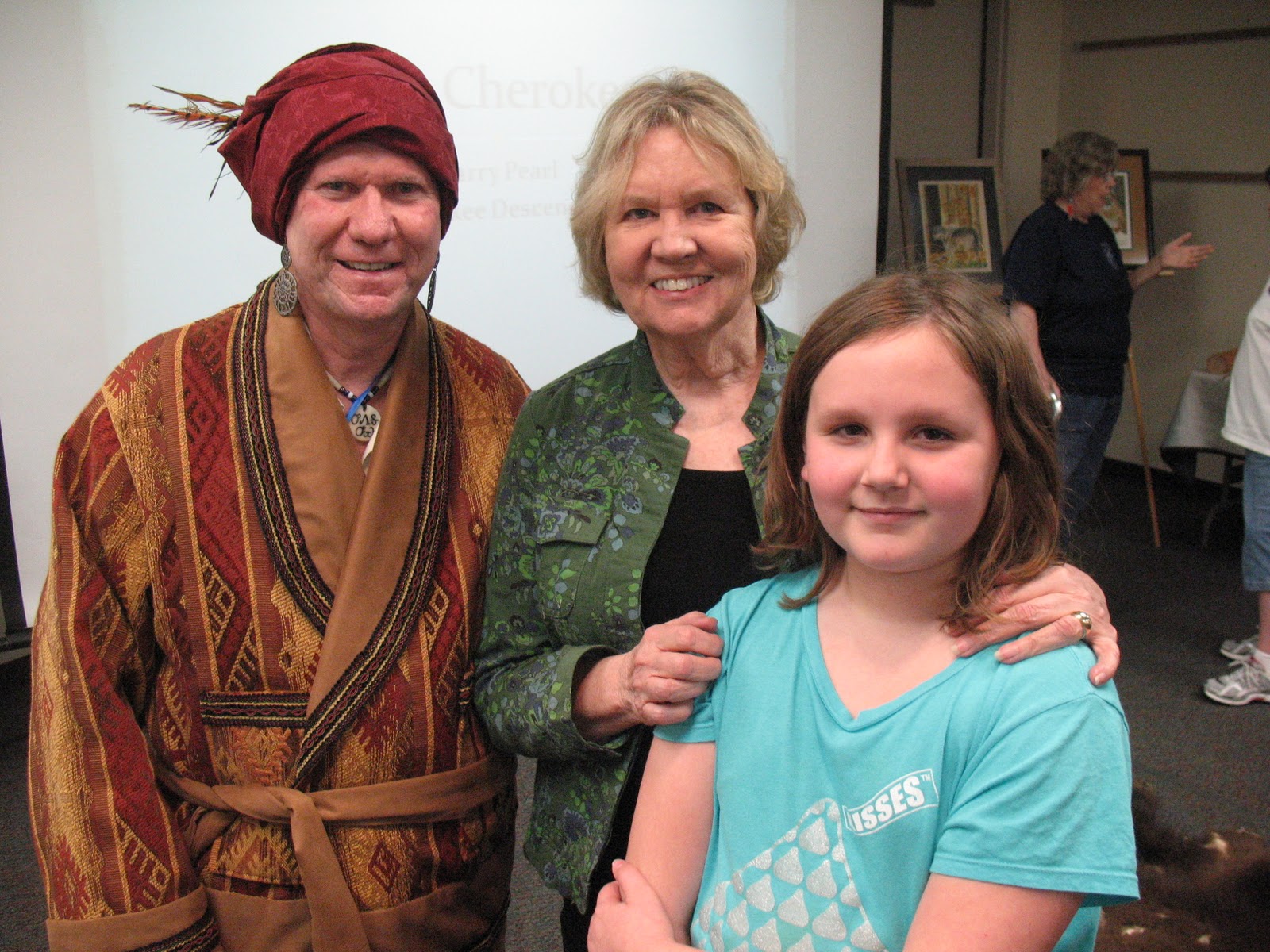
The library had a full house this Wednesday evening for Larry Pearl’s excellent presentation on the early life of the Cherokee people. Larry provided fascinating instruction on many of the key events in Cherokee and Native American history such as the Iroquois Confederacy, Sequoyah and the Cherokee language, and the Golden Age of the Cherokees, to name just a few. Larry also demonstrated his knowledge and ability with the Cherokee language. Along with an excellent PowerPoint presentation, Larry had two tables full of Cherokee art, instruments, weaponry, and research materials. During and after the Q & A session, many lively discussions ensued with audience members sharing stories and memories.