Saturday, July 20, 2013
Friday, July 12, 2013
Yesterday: Astronaut Jerry Ross at FPL
The library was honored to have astronaut and
Friendswood resident Jerry Ross speak to a full house yesterday evening at the
Friendswood Public Library. Jerry
provided fascinating information regarding his wonderful new book Spacewalker: My Journey in Space and Faith
as NASA’s Recording Setting Frequent Flyer. Using PowerPoint and narrating
his own video footage Jerry gave audience members a vivid look into the world
of astronauts and their work with the Space Shuttle and Space Station. Jerry
also took time to answer numerous audience questions.
Tuesday, July 9, 2013
3 questions with acclaimed local artist Ruby Allen
This past November, the Friendswood Public Library
hosted An Evening of Art with local,
award-winning and juried artists, Ruby Allen, Glena Schlehuber, and Billie
Morris. Recently, I was fortunate enough
to have acclaimed watercolor artist Ruby Allen answer a few questions about her
artwork for from the reference desk. The
art images that accompany this interview are from Ruby Allen’s work:
MR:
Your amazing watercolor paintings are world renowned and many here in
Friendswood enjoy collecting your work.
My wife and I purchased one of your watercolors many years ago and it
still hangs in our living area. Can you
tell us how you came to paint in watercolor and how this medium lends itself
especially to your creative vision?
RA: I
have chosen water based paints as my preferred medium because it is more
challenging than working in oils. I also
appreciate the freshness of watercolors when used wet on wet. The fusion can be
very exciting.
MR:
In preparation for the art exhibit we held here at the library last November, I
had the privilege of seeing your studio and speaking with you about your
art. One of the subjects we touched on
was the diverse styles of painting and mixed media that you have incorporated
into your work over recent years. Could you share your thoughts on this and
reflect a little on your more recent work.
RA: After
painting in pure watercolor for many years it was a natural sign of growth to
want to reach another plateau by incorporating other water based mediums. I never forget that no matter how
accomplished an artist may be, they are always a student.
I paint many abstracts because I find that they
afford me the opportunity to use my creativity to the max. Acrylic paint gave me the texture and depth
of colors that I wanted. In addition, the paintings were consistently chosen
for juried shows and were prize winners.
MR:
And finally, could you share with us some of your experiences in the world art
community. I know that your work has
been honored in other areas of the country and overseas. Could you tell us
something about these experiences? Does your art take you out of the country
often and do you enjoy these experiences?
RA: It
is very pleasing to know that people all over the world are enjoying my paintings,
including a “Ruby Wall” at the Russian News Agency in Moscow. Whether a patron is visiting in this country
or leaving to live in other parts of the world, it gives me a great sense of
pride that they select my paintings to provide them with the happiness that
they receive from my works.
In the words of Pablo Picasso, “The artist is a
receptacle for emotions that come from all over the place; from the sky, from
the earth, from a scrap of paper, from a passing shape, or from a spider’s
web.”
| l to r: Ruby Allen, Glen Schlehuber, and Billie Morris |
Saturday, July 6, 2013
check this out: fpl staff picks
Donald LeBlanc, Reference Librarian
The
Outpost: An Untold Story of American Valor by Jake
Tapper
In The
Outpost, acclaimed journalist Jake Tapper gives us the gripping saga of the
group of brave, doomed soldiers who were stationed at (Combat Outpost Keating).
Epic in ambition and conception, The
Outpost reads like the grand war novels of the past---The Thin Red Line, The Naked and the Dead, The Things They Carried---packed
with unforgettable characters, tension, violence, betrayal, love, and
heartbreak. Yet The Outpost is not fiction but brilliantly reported fact, the
result of hundreds of firsthand interviews in Afghanistan and around the world.
It is a masterpiece that, like Rudyard Kipling’s “The Man Who Would Be King,”
will be read a century from now by those hoping to understand what went wrong
in Afghanistan, and the courage of those who fought there.
---from the book jacket
Christina Hicks, Young Adult Librarian
The
Raven Boys by Maggie Stiefvater
From Maggie Stiefvater, the bestselling and
acclaimed author of the Shiver trilogy and The Scorpio Races,
comes a spellbinding new series where the inevitability of death and the nature
of love lead us to a place we’ve never been before.
---from the book jacket
Michelle Farthing, Circulation
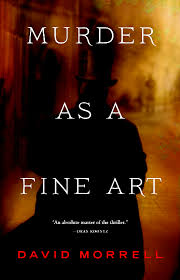
Murder
as a Fine Art by David Morrell
Thomas De Quincey, infamous for his memoir Confessions
of an English Opium-Eater, is the major suspect in a series of ferocious
mass murders identical to ones that terrorized London forty-three years
earlier.
The blueprint for the killings seems to be De Quincey's essay "On Murder Considered as One of the Fine Arts." Desperate to clear his name but crippled by opium addiction, De Quincey is aided by his devoted daughter Emily and a pair of determined Scotland Yard detectives.
In Murder as a Fine Art, David Morrell plucks De Quincey, Victorian London, and the Ratcliffe Highway murders from history. Fogbound streets become a battleground between a literary star and a brilliant murderer, whose lives are linked by secrets long buried but never forgotten.
---from Amazon
Just
Kids
by Patti Smith
In Just
Kids, Patti Smith’s first book of prose, the legendary
American artist offers a never-before-seen glimpse of her remarkable
relationship with photographer Robert Mapplethorpe in the epochal days of New
York City and the Chelsea Hotel in the late sixties and seventies.
An honest and moving story of youth and friendship, Smith brings the same
unique, lyrical quality to Just
Kids as she has to the rest of her formidable body of work—from her
influential 1975 album Horses
to her visual art and poetry. ---from Amazon
Mary Keever, Circulation Manager
The
Bat
by Jo Nesbo
The electrifying first appearance of
Jo Nesbø’s detective, Harry Hole.
Inspector Harry Hole of the Oslo Crime Squad is dispatched to Sydney to observe a murder case. Harry is free to offer assistance, but he has firm instructions to stay out of trouble. The victim is a twenty-three year old Norwegian woman who is a minor celebrity back home. Never one to sit on the sidelines, Harry befriends one of the lead detectives, and one of the witnesses, as he is drawn deeper into the case. Together, they discover that this is only the latest in a string of unsolved murders, and the pattern points toward a psychopath working his way across the country. As they circle closer and closer to the killer, Harry begins to fear that no one is safe, least of all those investigating the case. ---from Amazon
Tuesday, July 2, 2013
FPL's Off the Page Poetry Series presents John Milkereit
FPL's
Off the Page Poetry Series presents John Milkereit: reminiscing about
matchsticks. John Milkereit is an award-winning,
juried poet who has been featured at Houston Poetry Fest and Inprint's
prestigious First Friday poetry series. John's stand-up poetry is both
hilarious and thought-provoking. Not to be missed poetry event.
Wednesday, July 17 at 7pm at Friendswood Public
Library
![]() |
| from the cover of Paying Admissions by John Milkereit: Cover Art by Steve Taylor |
Rotating Equipment Engineer
A
rotating equipment engineer ought to land in a poem
because
I love the surprise of him
entering
a dimly-lit hallway
with
his sack lunch
ready
to say no to someone.
I
enjoy his negating self, his I-don’t-build-anything
kind
of job description.
What
he actually does is a mystery.
One
morning, his glasses could reflect from a computer screen
a
motor data sheet or the news that a volcano erupted in Indonesia—
you
would never know for sure. I’d want as many turns
in
the poem as the pumps he specifies. Words and shafts
are
traitors and dirty when the start button is pressed.
Parts
spin out of control, taking limbs off their operators.
I
reminisce about the days when he made more money
than
a doctor, when building factories was a revolution.
His
metal is so much like the sentence that takes so long
to
get poured, and welded, and bolted into its shape.
Why
not turn the result
over
to the rulers of the world?
With
a red pen mounted on his keyboard, he always waits,
ready
to reject a test.
He
can fly to a factory in a pair of steel-toed boots
to
witness what is ready to ship. No matter what he calculates,
or
whatever tools are hidden in his pocket, he is never finished.
Reminiscing
About Matchsticks
Remember
the best ones from nine-thousand years ago?
We
rubbed two together with our hands
causing
a resistance between two bodies
we
later learned was friction, and a fire
ensued
inside that cave, our cores warmed,
we
roasted what I killed, somehow we survived the winters.
Where
have the 1800s gone? We made small strips
of
wood and paper tipped with a combustible material.
We
lived in France for a while and upgraded to phosphorus.
Later,
we moved to America and found twelve in a book.
We
struck them using the tips of our fingers against a narrow
oxidizing
landing strip that I will never forget.
Have
you forgotten what happened last summer?
The
generic-jacketed ones had camped in an amber
rust
candle plate cussing and swapping stories about nothing.
They
punched plumeria candles across the walnut
grains
of our Queen Anne table. They avoided fallen rose
petals,
salt granulars, and sudden plateaus of newspapers.
They
even yanked a wagon of incense from Bangalore.
Yesterday
they rode from San Antonio in a box
labeled
Little Rhein Steak House,
Nick’s Fishmarket
swam downstream from Chicago
and
rendezvoused with The Daily Grind---
a local guide for the artic journey across the porcelain
tundra
of our bathroom. They climbed the toilet basin towing
a
candle layered in gardenia, seminole rain, and eggplant.
Certainly,
it was an adventurous time to be alive, or at least cold.
Today,
I am thinking about the extinguished ones of the past, their
brief
little lives caused us to survive, and rescued us
from
the jaws of boredom. I am even thinking about the future---
we
could fly them to another planet, a place we can only guess,
start
over again, and tell stories around a campfire,
stories
we can only imagine.
~John
Milkereit
Saturday, June 22, 2013
Astronaut Jerry Ross at FPL: excerpt from his book Spacewalker
Friendswood astronaut Jerry Ross will speak at the
Friendswood Public Library on Thursday, July 11 at 7pm.

Below is an excerpt from Spacewalker: My Journey in Space and Faith as NASA’s Record-Setting Frequent
Flyer by Jerry L. Ross.
ONE
Sputnik, a
mouse, and blackberry pie
When I was born on January 20, 1948, there
were no astronauts. There were no space capsules or Space Shuttles. There was no NASA and no International Space
Station. Orville Wright ---who with this
brother, Wilbur, designed, built, and flew the world’s first airplane---was
still alive. He died ten days later at the age of seventy-six.
Airplane flight was barely forty-four
years old, and the term “Jet Age” was so new it was rarely used. The real “Jet Age” was still a few years
away, and the “Space Age” would drop right on top of it as daring pilots such
as Chuck Yeager pushed the boundaries of possibility. On October 14, 1947, Chuck had piloted the
Bell X-1 airplane and flew faster than the speed of sound for the first time.
The only spacemen in 1948 were Buck Rogers
and Flash Gordon, and they were in comic books and movies. While space had captured the imaginations of
science fiction writers and some scientists, the public viewed spacemen as
whimsically as the “Man in the Moon.” Space travel was still a fantasy.
In 1948, Virgil “Gus” Grissom, who later
would become the second American in space and the first person in the world to
be launched twice, was a sophomore studying engineering at Purdue University,
seventy miles south of my northern Indiana hometown. He’d probably never heard
the word “astronaut.” He wanted to be a United States Air Force pilot. Neil Armstrong was an eighteen-year-old
Purdue freshman with no idea that in twenty-one years he would put his
bootprints on the Moon.
While they could not know what lay ahead,
the future was brewing inside them as they walked across the redbrick campus
carrying thick calculus and physics textbooks and slide rules holstered in
leather cases. The next twenty-one years would transform the world, and I lived
through it. It made me what I am today.
I am an astronaut.
In my life I have seen views of Earth and
the universe from a perspective once known only to God. Any yet, I grew up in a time so distant from
today that electric can openers were considered high tech. And my family didn’t
have one.
I have launched into space seven times and
ventured into the blackness of the universe on nine spacewalks.
From two hundred miles high I have watched
lightning pop through dark clouds stretched across the Amazon, seen the
Himalayas reach up to greet me, and looked down at the Indiana hometown from
where I once looked up at the stars.
The world we live in today was
unimaginable when I was a boy, and space has made the difference. In the twenty-first century, all of us are as
closely linked to space as the cellular phones in our pockets. We are linked to space by television,
financial transactions, the Internet, weather forecasts, and GPS. The technology we employ every day has been
made possible by space systems. Our
exploration of space has not only opened up the universe and fostered new
technologies that we use here on Earth, but it has also taught us about our planet
and its environment. The impact has been revolutionary.
Thirty years of that exploration was
dominated by a ship that was launched, returned to Earth, and sent back into
orbit again---the Space Shuttle. We were
awed by it, inspired by it, and sometimes saddened by it. And I was there for it all---from the first
Shuttle mission to the last. It was the
adventure of my life. Now the Space
Shuttle program has run its course, the orbiters are in museums, and I am very
concerned that America is walking away from its hard-earned leadership in
space.
Our missions were filled with danger,
excitement, hard work, tension-breaking laughter, and good times as we launched
off the face of the Earth in an explosion that could be seen, heard, and felt
miles away. We did things no one had
ever done before. I want to share the
amazing experiences I had pursuing my dream and help you understand what it
felt like to ride those rockets and walk in space.
We saw views that no camera has ever been
able to fully capture. Seeing the beauty
of Earth from orbit along with the enormity, complexity, and the order of the
universe strengthened my faith in a loving God who gave us a beautiful, fragile
place to live. I want to share how God
has directed my path with the hope that others will choose to experience their
own journeys in faith.
My journey wasn’t easy. It was difficult. It came with all the failures and setbacks
that are part of life. I reached my
dreams by always believing in them---no matter how distant they seemed---and by
sticking with them through trial, error, and success. I want you to know that the incredible dreams
inside you, whatever they might be and wherever they might take you, can be
within your grasp if you believe and persevere.
My journey in space, faith, and life all
began at the same time, in the same place, in the all-American Midwest town of
Crown Point, Indiana, in an era when the Moon was still unreachable but a boy’s
dreams could take him to the stars…
Tuesday, June 18, 2013
last night: Louisiana Rogue
Local author Harold Raley shed insight into the
making of his fabulous new novel Louisiana
Rogue with a full house at the Friendswood Public Library. The audience learned about rogue novels and about
the historical events and locations running throughout Louisiana Rogue. The Friendswood
Public Library was honored to host this book release event.
Saturday, June 8, 2013
National Spelling Bee Championship Round speller Syamantak Payra at FPL
Syamantak Payra of Friendswood made it into the
Championship Round of the Scripps National Spelling Bee! Syamantak also won a gold medal in the
Physics/Astronomy division at this year’s CCISD Science Fair. The Payra family sent the Friendswood library a
very nice message:
We
are so proud of the Friendswood Public Library - it has a wonderful collection
and we love the warm, cordial nature of all the staff members. In fact,
Syamantak used a lot of materials from the Friendswood Public Library while he
was preparing for the National Spelling Bee!
The Friendswood Public Library is also proud of Syamantak and all of his amazing accomplishments!
![]() |
| Syamantak Payra with his parents and FPL staff member Michelle Farthing (2nd from left) |
Thursday, June 6, 2013
Tuesday, June 4, 2013
excerpt from Harold Raley's Louisiana Rogue
Author Harold Raley will speak about his new book,
Louisiana Rogue, at the Friendswood
Public Library on Monday, June 17 at 7pm.
Below is an excerpt from Harold Raley’s Louisiana Rogue: The Life and Times of
Pierre Prospère-Tourmoulin:
Part
III: How Peter descended from the heavens and was reunited with Father
Branigan; his seminary studies for the priesthood; how He and Lawler Adkins
were cleverly relieved of their funds and left holding a braying ass; and how
they parted ways.
Far, far from Memphis I flew in fair Caroline’s
balloon. Hours passed as the south wind
moaned and the basket swayed and creaked, carrying me with immeasurable
velocity along the serpentine course of the Mississippi. Occasional river craft greeted my passing
with their deep-throated horns, and I could make out the ant-like figures of
passengers waving their tiny arms at me.
The day finished and night passed as the balloon
continued its uncharted celestial trajectory.
As morning broke again, I perceived that my curious conveyance had
descended alarmingly from its once majestic career. Only then did I espy the
bullet hole from which the captured gas was escaping. It was too high for me to
reach, and even by some unlikely maneuver I should attain it, I had no means at
my disposal for stanching its wound, nor of knowing whether the bullet had torn
another hole opposite the first. A
desperate thought crossed my mind that by discarding the coins I might gain
time and distance, for a survey of the landscape now revealed only a
featureless expanse of swampy desolation.
This alternative I rejected out of hand: it was better to fall rich than
float poor.
But
upon closer inspection of my purloined fortune, it appeared that float or fall,
I would not do so as a rich man. The sum
was vastly inferior to my expectations, barely exceeding two hundred
dollars. Indeed some of the
coins---sixty or seventy unless my memory fails---were Spanish milled dollars,
but the others---greater in number---were inferior American coins worth much
less. I cursed Pollard anew.
By
noonday I was riding at treetop level, and before another hour passed the
basket touched ground, at first with a mere brush, then with rude bounces and
the crashing of branches and slapping of grasses. I was reconciled to ending my flight on this
contemptible terrain when a gust of wind lifted me momentarily above the trees
and carried me towards what appeared to be a forested creekbed. The balloon swooped into the dark void, made
a valiant effort to clear the opposing slope and with a stunning thud slammed into profuse
underbrush. The basket was demolished by
the impact and I, thrown clear of my craft, rolled several meters towards the
water. The chemise and cravat were
stained by dirt and grass, and I abandoned them with a momentary sadness.
Like a
dying behemoth, the balloon billowed and rippled as it strained to lift itself
from the ensnarling branches. But its
life was spent, and gradually the valentine heart settled to its death, draped
across the scrub. My flight had ended. I had come to earth again, though I knew
not where or in what circumstances.
Shedding
my dress, I strapped my coins and other possessions around my body, then slid
and stumbled my way down to the creek bed. No doubt I exaggerate by giving such
a wholesome appellation to the paltry stream I discovered there. For in truth it was but a sliver of water
meandering from pool to pool amidst sandy banks. On these I perceived a
multitude of animal tracks, but ignorant of nature and lacking the hunter’s
eye, I could not discern whether they were of beasts placid or predatory. Nor found I any human trace amongst them.
I was
ravenously thirsty and hungry. I slaked
my thirst in one of the pools, but the prospects for food were so unlikely as
to conjure up before me the fearful specter of starvation. I saw fish darting about in the deeper pools,
but without hook and line or spear to snare them or fire to cook them, I could
fathom no means of converting them into sustenance. Searching further downstream, I discovered a
few late-season blackberries that I devoured in frenzied haste.
The
berries and water abated my appetite sufficiently for me to consider my options
with a clearer head. My earlier aerial
survey of the landscape afforded me no clue of human habitation and dispelled
any profitless thought of abandoning the creek bed for the forested plain.
As I
pondered these dreary possibilities, I thought to perceive human voices, but
listening intently for a time, I saw no one and decided with some concern for
my health that my mind, weakened by all that beset me, was playing tricks on me…
Subscribe to:
Posts (Atom)